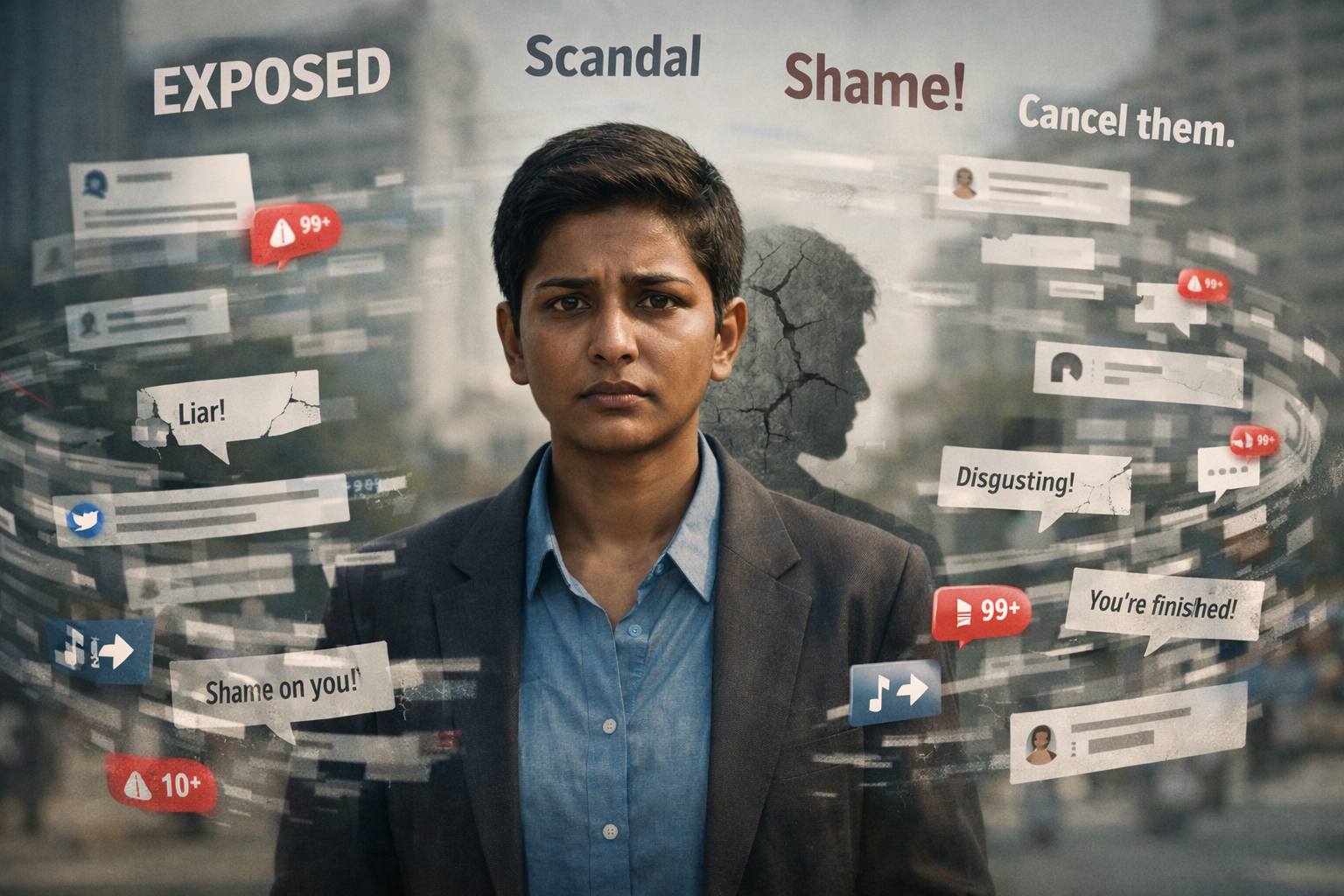
Introduction: One Video. Seconds of Footage. A Destroyed Life.
It starts quietly.
Someone pulls out their phone. They record. They post. They tag. And within hours — sometimes minutes — a person's name, face, and worst moment is circulating across Facebook groups, WhatsApp threads, and TikTok feeds from Colombo to Kandy, Galle to Jaffna.
The comments flood in. The shares multiply. Strangers who have never met the person — who have no context, no full story, no relationship — pass their verdict with absolute certainty. By the time a second video surfaces with more context, or the truth emerges, it no longer matters. The damage is done.
This is character assassination via social media. And in Sri Lanka today, it is happening with alarming frequency, devastating consequences, and almost no accountability.
At Persona Mind, we believe that what our society is witnessing is not simply "online drama." It is a deeply serious psychological and social phenomenon — one that is reshaping how we treat each other, how we process conflict, and how vulnerable individuals experience their own identity and worth.
In this article, we unpack the psychology behind viral shaming culture, explain the devastating impact of character assassination in the digital age, and explore what we — as individuals and as a society — can do differently.
What Is Character Assassination via Social Media?
Character assassination is the deliberate and sustained effort to damage or destroy a person's reputation, credibility, or social standing. In its traditional form, it involved gossip, rumour-spreading, or coordinated smear campaigns. Today, it has evolved into something far more powerful and far less controllable.
On social media, character assassination can be triggered by:
- A video clip shared without context, depicting someone in a moment of anger, vulnerability, or poor judgement
- A screenshot of a private conversation made public
- A coordinated campaign by a group of individuals targeting one person
- A misidentification, where the wrong person is accused of wrongdoing entirely
- Deliberate fabrication — edited videos, manipulated images, or false narratives shared as truth
What makes the digital version uniquely destructive is its permanence, speed, and scale. A rumour whispered in a village bazaar reaches a few dozen people and fades over time. A shaming video shared on Facebook reaches thousands within hours — and lives on the internet indefinitely.
The Viral Shaming Culture: How It Works in Sri Lanka
Sri Lanka's social media landscape has grown explosively over the past decade. With over 7 million Facebook users and a rapidly growing TikTok presence, platforms that were once spaces for connection have increasingly become arenas for public trial and punishment.
The pattern of viral shaming in Sri Lanka tends to follow a recognisable cycle:
Step 1 — The Trigger Post: A video, image, or screenshot is posted, often by someone with a grudge, a sense of moral outrage, or simply a desire for engagement.
Step 2 — The Algorithm Amplifies: Facebook and TikTok's engagement-based algorithms detect the emotional reaction — outrage, shock, disgust — and boost the content to wider audiences.
Step 3 — The Pile-On Begins: Comment sections fill with condemnation, insults, threats, and mockery. The target's personal information — workplace, address, family members — is often exposed through what is known as "doxxing."
Step 4 — The Shares and Groups: The content spreads to WhatsApp groups, Facebook groups, and community pages. It is reposted, screenshot, and re-shared, each iteration reaching a new audience with no original context attached.
Step 5 — Real-World Consequences: The target faces harassment at home, threats at work, damaged relationships, job loss, and in severe cases, physical danger. In multiple documented cases in Sri Lanka, victims of viral shaming have experienced serious mental health crises, including suicidal ideation.
Step 6 — The Silence After: The internet moves on to the next outrage. But the target is left to rebuild a life that has been publicly dismantled — often with no apology, correction, or accountability from those who participated.
The Psychology Behind Viral Shaming: Theories That Explain the Mob
To understand why this happens — and why it is so difficult to stop — we need to look at the powerful psychological forces at work beneath the screen.
1. Moral Disengagement Theory (Albert Bandura)
Albert Bandura, one of the most influential psychologists of the 20th century, developed the concept of Moral Disengagement — the psychological process by which ordinary people suspend their ethical standards to participate in harmful behaviour.
In viral shaming, moral disengagement operates through several mechanisms:
Moral Justification — Participants convince themselves that the shaming is righteous. "They deserved it." "The public has a right to know." "Someone had to say something."
Dehumanisation — The target is reduced to their worst moment. They are no longer a full human being with a complex life — they are the villain of a thirty-second clip. Once dehumanised, harming them feels less morally troubling.
Diffusion of Responsibility — With thousands participating, each individual feels personally responsible for very little. "I was just sharing it." "I only left one comment." "Everyone else was saying the same thing."
Bandura's theory helps explain one of the most disturbing aspects of viral shaming: that it is not carried out primarily by cruel or malicious people. It is carried out by ordinary people who have psychologically justified their cruelty to themselves.
2. The Social Comparison Theory (Leon Festinger)
Leon Festinger's Social Comparison Theory tells us that humans have a deep, instinctive drive to evaluate their own worth by comparing themselves to others. In environments of scarcity, stress, or low self-esteem, this comparison tends to become downward comparison — we seek out people who appear worse than us to feel better about ourselves.
Viral shaming feeds this need directly. When we share a video of someone behaving badly, we are implicitly positioning ourselves as better — more moral, more reasonable, more in control. The comment section becomes a collective performance of superiority.
In Sri Lankan cultural context, where social status, family reputation, and community standing carry immense weight, the urge to distance oneself from a "shameful" person — and to visibly align with those condemning them — is particularly powerful.
3. Schadenfreude and the Reward Circuit (Neuroscience)
Neuroscience offers another disturbing insight. Research has shown that witnessing the misfortune of others — particularly those we perceive as morally inferior or as having "gotten what they deserve" — activates the brain's reward circuit, releasing dopamine.
This phenomenon, known in psychology as Schadenfreude (pleasure derived from another's suffering), means that participating in viral shaming can feel genuinely good in the moment. The brain is rewarded for engagement. And when the algorithm then shows you more of the same content, a feedback loop of reward and repeated engagement is created.
This is not a character flaw unique to cruel people. It is a neurological response that all human beings are capable of — and one that platform designers understand and exploit through algorithmic amplification of outrage.
4. Public Shaming as Social Control (Erving Goffman)
Sociologist Erving Goffman's concept of Stigma is essential to understanding character assassination. Goffman described how societies manage "spoiled identity" — attaching a stigma to individuals who violate social norms, marking them as fundamentally different from "normal" society.
In traditional Sri Lankan communities, this function was served by gossip, social ostracism, and community judgment — processes that, while painful, operated at a limited scale. Today, social media has industrialised stigma. A single viral post can attach a permanent, searchable, shareable stigma to a person — one that follows them into job interviews, relationships, and new communities for years.
Goffman's work helps us see that viral shaming is not random cruelty. It is a form of social control — a mechanism by which communities enforce norms by publicly destroying those who violate them. The problem is that in the digital age, this mechanism has become wildly disproportionate, often inaccurate, and entirely without due process.
5. The Spiral of Silence (Elisabeth Noelle-Neumann)
Why does no one speak up when a viral shaming pile-on is clearly going too far?
Political scientist Elisabeth Noelle-Neumann's Spiral of Silence Theory provides the answer. She found that individuals are highly sensitive to the perceived opinions of those around them, and that people tend to suppress views that seem to be in the minority — fearing social isolation.
In a viral shaming thread where thousands are condemning a person, the perceived majority opinion is overwhelming. Those who feel sympathy for the target, or who recognise that the situation is more complex than it appears, stay silent. Not because they are heartless, but because speaking against the mob feels dangerous — they risk becoming the next target.
This silence then reinforces the illusion of unanimous condemnation, driving the spiral ever deeper.
6. Identity-Based Trauma and the Shattered Self (Erik Erikson)
Erik Erikson's theory of Psychosocial Development emphasises that a stable sense of identity is foundational to psychological health. When a person's public identity — the self they present to their community — is suddenly and violently destroyed, the psychological impact is profound.
For victims of character assassination and viral shaming, the experience often involves what therapists describe as identity disruption — a shattering of the coherent self-narrative they had constructed. They are no longer "the person they were before the video." They are now defined, in their own mind and in the minds of those around them, by their most publicly humiliating moment.
This is particularly devastating in Sri Lanka's collective culture, where identity is deeply intertwined with family honour, community belonging, and social reputation. To be publicly shamed is not just to suffer personally — it is to feel that your entire family, caste, or community has been dishonoured alongside you.
The Specific Harm of Viral Videos: Why "Seconds of Footage" Is Never Just Seconds
A viral shaming video is not simply a recording of an event. It is a radically decontextualised fragment of a person's life, stripped of history, nuance, and humanity — and presented to an audience primed for judgment.
Consider what is lost in thirty seconds of footage:
- The events that led up to the incident
- The person's mental state, personal circumstances, or trauma history
- The relationship dynamics between those filmed
- Whether the person has already acknowledged, apologised for, or addressed their behaviour
- Whether the video itself has been edited, manipulated, or taken out of sequence
The human brain, however, is not designed to process these absences. We are pattern-recognition machines, and when presented with a clear villain and a clear narrative, we accept it. Psychologists call this the Narrative Fallacy — our tendency to construct coherent stories from incomplete information and treat those stories as truth.
Viral shaming videos exploit this cognitive tendency with devastating efficiency.
The Long-Term Psychological Impact on Victims
At Persona Mind, the effects we see in individuals who have experienced character assassination via social media are serious, complex, and long-lasting.
Acute Phase (Days to Weeks After the Incident): Victims typically experience panic, hypervigilance, inability to sleep or eat, and acute anxiety. Many describe the sensation of being physically hunted — constantly checking their phone, dreading what new attack may have emerged while they slept.
Subacute Phase (Weeks to Months): Depression, social withdrawal, and occupational dysfunction become pronounced. Many victims lose their jobs — either because their employer has seen the viral content, or because they are unable to function under the psychological weight of the harassment. Relationships fracture as family members who have also been exposed to the content distance themselves out of shame.
Chronic Phase (Months to Years): The permanent nature of internet content means that recovery is complicated by the fact that the shaming material rarely disappears. Victims report searching their own names and re-exposing themselves to the content compulsively — a behaviour consistent with trauma re-exposure loops seen in Post-Traumatic Stress Disorder.
Identity reconstruction — the long, difficult work of rebuilding a stable sense of self after public humiliation — can take years and is significantly more effective with professional psychological support.
The Impact on Witnesses and Participants: A Harm Often Overlooked
It is not only the direct targets of viral shaming who are psychologically affected.
For Active Participants: Regular engagement in shaming culture gradually erodes empathy. The brain becomes habituated to the dopamine reward of outrage, requiring increasingly intense content to produce the same response. Over time, the capacity for nuanced moral reasoning — the ability to hold complexity, extend benefit of the doubt, and resist the pull of the mob — is diminished.
For Passive Witnesses: Watching viral shaming repeatedly, even without participating, contributes to what psychologists call Compassion Fatigue — emotional exhaustion from exposure to others' suffering that leads to numbness and disengagement. Witnesses also internalise a message: this could happen to me. This ambient fear can produce self-censorship, social withdrawal, and a chronic low-level anxiety about one's own vulnerability to public exposure.
For Young People Especially: Adolescents and young adults, whose sense of identity is still forming, are particularly vulnerable to the distorted social norms that viral shaming culture creates. When young Sri Lankans grow up watching public humiliation treated as entertainment, it shapes their understanding of conflict, accountability, justice, and human worth in profoundly unhealthy ways.
The Cultural Dimension: Honour, Shame, and Sri Lankan Society
Sri Lanka's cultural framework adds a critical layer to this discussion. Ours is a society in which honour (nama) and shame (lajja) are not merely individual experiences — they are collective, familial, and deeply tied to caste, class, and community identity.
This cultural context means that the impact of public shaming in Sri Lanka operates on multiple levels simultaneously. When a person is shamed online, they experience not only their own distress but the weight of what they perceive as bringing shame upon their parents, their children, their extended family, and their community. This compounding of individual and collective shame can be psychologically overwhelming in ways that may not be fully captured by Western psychological frameworks.
It also means that the act of shaming carries a particular cultural weapon in Sri Lanka — one wielded not merely to punish an individual, but to damage the social standing of an entire family unit. This is frequently understood and deliberately exploited by those who initiate character assassination campaigns.
At Persona Mind, we work within this cultural reality. Effective support for victims of viral shaming in Sri Lanka must acknowledge and address both the individual psychological wound and the collective cultural experience of shame.
What Needs to Change: Individual, Community, and Systemic Responses
Addressing the viral shaming culture requires action at multiple levels.
As Individuals
Pause before you share. Ask yourself: Do I know the full story? What is my motive for sharing this? Could this post cause disproportionate harm to a real human being?
Resist the reward. Recognise that the satisfaction you feel when engaging with outrage content is a neurological response being deliberately triggered by platform design. You are not "seeking justice" — you are being rewarded for engagement.
Speak up safely. When you witness a pile-on going too far, a single calm comment — "There may be more to this story" or "Let's consider the impact on this person's family" — can interrupt momentum and plant a seed of doubt in others reading.
Protect your own mental health. Limit your exposure to outrage-based content. Curate your feed deliberately. Mute, unfollow, and block content that consistently leaves you feeling worse.
As a Community
Sri Lanka needs a wider cultural conversation about digital ethics and accountability. Schools, universities, religious institutions, and community organisations all have a role to play in building the social norms that will govern our digital behaviour.
We must also create space for empathy toward victims of viral shaming — recognising that the person in the video is a whole human being with a life, a family, and a right to dignity — regardless of what they may have done.
As a Society
Sri Lanka's legal framework around cyberbullying, defamation, and online harassment is still developing. Advocacy for stronger, clearer, and more accessible legal protections for victims of character assassination is essential. Victims must have viable pathways to seek redress — including the removal of harmful content and accountability for those who deliberately initiate campaigns of public humiliation.
If You Are a Victim of Viral Shaming: You Are Not Alone
If you are reading this because you or someone you love has been the target of character assassination or a viral shaming campaign, we want to say this clearly:
What has happened to you is not justice. It is not accountability. It is harm.
Your worth as a human being is not determined by a comment section, a share count, or the volume of strangers who have rendered a verdict on your worst moment without knowing you.
Recovery is possible. Identity, once shattered, can be rebuilt — with time, support, and the right therapeutic environment. Many people have walked through the experience of viral shaming and found their way to a life of meaning, connection, and restored self-worth on the other side.
You do not have to do this alone.
Conclusion: We Are Better Than This
The viral shaming culture did not arise because Sri Lankans are cruel. It arose because we have been handed tools of extraordinary power — tools that were designed not for human flourishing, but for engagement — and we have not yet developed the individual, cultural, or systemic wisdom to use them responsibly.
Character assassination via social media is one of the defining mental health and human rights challenges of our digital age. It demands our attention, our empathy, and our willingness to reflect honestly on our own behaviour when we reach for our phone to share, comment, or join the crowd.
At Persona Mind, we are committed to accompanying Sri Lankans through the psychological realities of the digital world — with honest, evidence-based insight and compassionate, culturally grounded care.
Because how we treat each other online is a reflection of who we are. And we believe we can do better.
Seek Support With Persona Mind
If you are experiencing the psychological effects of character assassination, viral shaming, or digital harassment, our qualified therapists are here to help.
We offer confidential, culturally sensitive counselling for individuals and families navigating the mental health impacts of social media harm.
📍 Visit: www.brandnva.site
📲 Follow us on Facebook and LinkedIn for weekly mental health content
© 2025 Persona Mind. All rights reserved. This article is intended for informational and educational purposes and does not constitute professional psychological advice. If you or someone you know is in crisis, please contact a qualified mental health professional immediately.